Ingo Noka

Archive for 2013|Yearly archive page

Thailand – Live Updates

In Flight Log, Navigation on July 26, 2013 at 11:35 pm

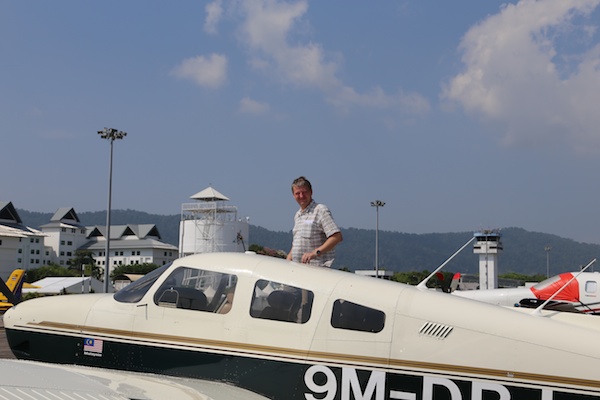
9MDRJ Refuel Stop

I am ready to go.  Flight plans are filed, bag is packed and lots of paper printed out in the hope that I will find the information when I need it.

Live Updates will appear on Facebook and Twitter  and I will attempt to post a summary of my exploits every day, but cannot guarantee I will have enough energy left in the evening.

If the weather is VMC at Seletar tomorrow morning, I will try to take of by 7:30 am, so that I can be in Penang before noon and in Hat Yai by 2 pm.

First fuel stop is Penang, but I am not going to fill up to the top, because I have to buy fuel in Hat Yay in 100L increments.  I am hoping they will keep the fuel I don’t need tomorrow for two days, so that I do not waste too much fuel.

A new challenge – Thailand, Part III

In Flight Log, Knowledge, Navigation on July 24, 2013 at 1:24 pm

Saturday is getting closer and with this my flight to Thailand. I am so looking forward to an entire week of flying in Singapore, Malaysia and Thailand. Apart from the Thailand flight, which has a fixed route and timing, I will fly wherever the wind takes me. Heaven!

The Thai flight permit came through last Thursday. That was surprisingly fast and without much of a problem. I am cleared for a flight to VTSS and VTSW on Saturday and back on Monday. I am allowed to postpone by up to 24 hours, after which I will have to ask for a new permit.

Phuket Airpark kindly sent me an invitation letter, which helped with the Thai VFR permit. They are a bit concerned with some guy they don’t know flying into their short, soft grass strip and I will certainly try to get my landing and take-off right to be welcome again at some time in the future.

The only uncertainty is now the availability of Avgas in Hat Yai. It would be extremely disappointing if I had to cancel at the last minute, because of that. Maybe I would just fly into Hat Yai and come back, which is short enough to get away without refueling outside of Malaysia.

Read the rest of this entry »

How much is it?

In Aircraft, Knowledge, Ownership on July 20, 2013 at 8:39 pm

Busy Senai Airport and Beautiful Flying Weather

Today we had beautiful flying weather and Senai airport was teeming with GA activity.  A heart warming sight after many weeks of being grounded because of haze and recently because of aircraft maintenance.

On a day like this it is bad form to talk about money, but anyway, today I picked up 9MDRJ  after the Annual Maintenance and paid a couple of bills, which prompted me to provide some pointers to the operating cost of small Malaysian registered GA aircraft.

Read the rest of this entry »

A new challenge – Thailand, Part II

In Navigation on July 11, 2013 at 11:01 pm

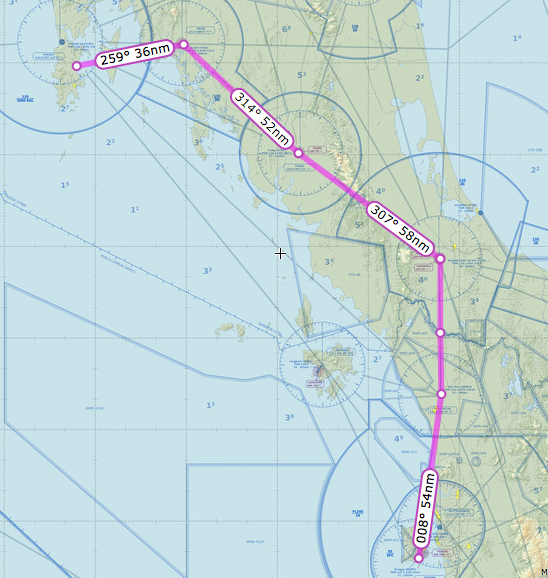
Penang to Phuket via Hat Yai

I am exited about my plans to fly into Thailand.  Wings over Asia is helping me with the flight permit and I hope I am not too late with my application.  They told me that the Thai ATC will need at least 5 working days to respond.

Initially I thought I would go the coastal route and refuel at Phuket International.  I was advised not to do that, though.  Apparently that airport has a bad reputation among private pilots.

So now I am thinking I should go to Hat Yai for refuel and from their to the Phuket Airpark via Krabi.  On the way I have at least Trang and Krabi as alternative landing sites in case the weather gets bad.

As far as I can see there are two obvious entry points into Thai airspace, which are defined by the intersection of the national border and two airways:

  • DUBAX for airway R325 (Alor Star to Phuket) – basically Kuala Perlis
  • TAMOS for airway A457 (Alor Star to Hat Yai)

I am planning to use TAMOS and entry and exit point, because that point is crossing the border on a direct line from Alor Star to Hat Yai.

The Thai AIP is very similar to the Malaysian one.  The VFR rules, for example, are basically the same.  Surprisingly, for Hat Yai and Phuket there are even VFR reporting points defined in the AIP.

I have updated the Google map with some Thai VFR reporting points here.

A new challenge – Thailand

In Flight Log, Navigation on July 8, 2013 at 9:56 pm

Phuket Airpark, short 500m grass runway

Unfortunately the flight to Bali, originally planned for the last week of July, has been postponed to August and I have already arranged all my holiday and travels and cannot change again.  So what to do?  I decided I will fly into Thailand.  Maybe it is too late to apply for the permission to fly into Thai airspace, but I will try anyway.  The plan is to fly from Singapore to Penang and from Penang to Phuket.  On Phuket I am asking the Phuket Airpark to help me with the logistics.  I hope there is Avgas available at Phuket airport and the Airpark owners let me park my plane for a night or two.  Depending on weather, I may stop over on Langkawi and in Ipoh on my way back.  ETD Singapore is Saturday, 27 July and return on 31 July or 1 August.  Maybe other pilots who also took a couple of days off for the Bali flight want to join?  Please let me know.

Aviator’s Gathering

In Flight Log, Navigation, Social Life on June 30, 2013 at 8:25 pm

I had a whale of a time flying with WoA to the Annual Aviator’s Gathering 2013 on Langkawi

Flight Summary
Dates 8 March – 10 March 2013
Engine Time 11h 17m
Landings 6 – WMSA, WMKP, WMKL, WSSL
Fuel total approx. 100 Gallons
Fuel per hour approx. 8.5 Gallons
Pictures Click here

The Annual Aviators gathering of Wings over Asia was a magic weekend of flying and meeting like-minded people.  The crew of WoA did a great job in the friendly and efficient manner that we have all come to expect from them. They put together a great program, which started with a flight from Singapore to Kuala Lumpur and a dinner in a new aircraft hangar at Subang airport.

Dinner at a new aircraft hangar at the GA area Subang Airport

I usually keep the aircraft at the Skypark and had no idea that there is a whole GA area further down with parking stands, hangars etc. There is a lot more going on in GA flying in Malaysia than meets the eye.  It was pretty cool to sit between helicopters and airplanes while eating, drinking (no alcohol) and listening to talks about general aviation in Asia.

Read the rest of this entry »

Pulau Redang Revisited

In Knowledge, Navigation on June 25, 2013 at 12:15 pm

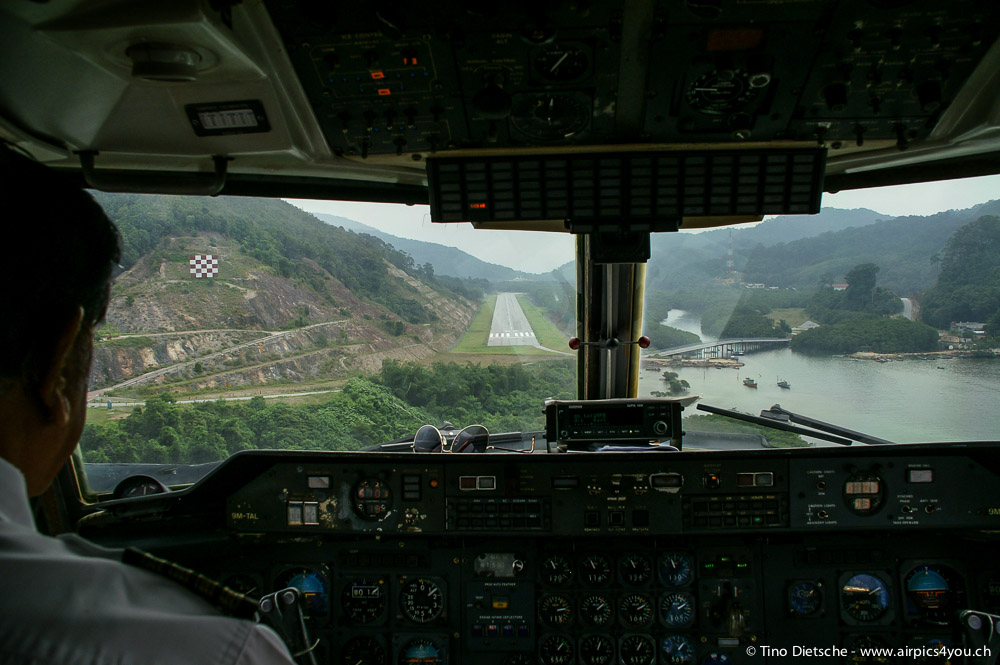
Berjaya Air – Approach to Pulau Redang (Copyright Tino Dietsche)

Pulau Redang is a small island off the East Coast of Malaysia. It has a small runway and is a favorite flying destination for many pilots from Singapore or Malaysia. As with many of these small airports, the problem is Avgas supply and immigration facilities.

One of the WoA pilots stopped over at Pulau Redang on our way back from the APFT Air Carnival and he was kind enough to send me some new information about the procedures at Pulau Redang. (I had written earlier about Redang in this post.)

Avgas is obviously not available on the island. In fact, Petronas does not offer Avgas anywhere along the East coast. However, APFT, based at Kota Bahru and Terengganu assured us that they would be happy to sell Avgas at both locations as long as we tell them in advance. I have the contact details, but do not want publish them here. Feel free to contact me, if you want to get in touch with them.

One option to complete the immigration and customs formalities would be to stop at Senai Airport (for the Singapore crowd) or to do it at Kota Bahru. I am not so sure about Terengganu, but I have done it at Kota Bahru. However, you need to check whether they are open, because immigration is only around when international flights depart or arrive.

The much better option is to do the immigration and customs on Pulau Redang. The immigration officer is around whenever a Berjaya Air flight is arriving and departing. At all other times you will have to inform them of your ETA. You should use this form and fax it directly to the airport manager Mr. Fendi. In any case, you will have to arrive between 8 am and 5 pm local time.

Your aircraft can be parked over night at the airport. With the aircraft tail hanging over the edge, there should be space for a maximum of three small planes. Parking is free for the first three hours, How much it is thereafter I don’t know. I know however that the landing charge is Ringgit 15.50.

Well, there it is. I hope this helps a bit. Please let me know if you have information about any of the other flying destinations in South East Asia.

(BTW: The title picture was taken by Tino Dietsche who graciously let me use it on my blog. He has written a nice article on his flight to Redang here.)

Using Mogas in Malaysia

In Knowledge, Navigation, Ownership on June 23, 2013 at 6:24 pm

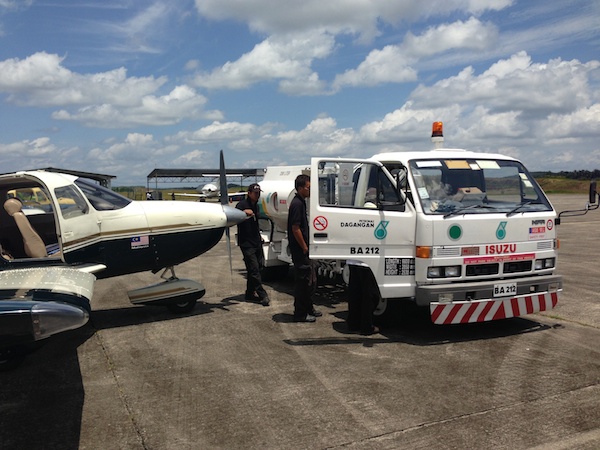
Petronas Fuel Truck at Senai Airport

After my post on aircraft choices, which touched on the subject of fuel availability in South East Asia, I got a few questions whether it is possible to convert an Avgas CofA aircraft to Mogas.

Common wisdom in the Malaysian GA community is that the DCA of Malaysia does not permit Mogas for CoA aircraft. There is an Airworthiness Notice No 42 dated 1 April 1987, which does not seem to close the door to the use of Mogas altogether, but sends the message that any attempt to get this approved for an aircraft on the Malaysian register will cost more than what you can ever hope to save by switching to the cheaper fuel.

Read the rest of this entry »

Flight Plans in Malaysia

In Flight Bag, Knowledge, Navigation on June 16, 2013 at 10:54 am

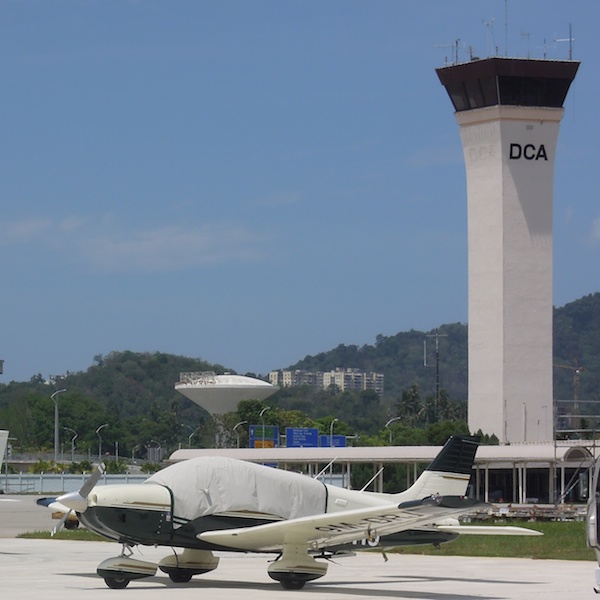
DCA Tower Penang

The Malaysian ATC expects you to file a flight plan for all VFR flights, unless you just stay in the training areas or do a few circuits to practice your landings.

Most pilots will fill in a flight plan form on paper and fax it to the ATC unit of the departure airport. ATC will forward the FPL using the usual data exchange network. That means most of the formatting will be done by the controller and the pilot does not really need to know much about the FPL message formats.

As soon as you are crossing borders, this changes, however. Suddenly you are confronted with the need to send your flight plan to all control units along your proposed route and you have to be careful with the formatting and completeness of your flight plan message.

I have found two flight plan filing systems that work very well for me. The first one is a web based system from the UK, which is available under www.eurofpl.eu. The second one is a Java application that is provided by the Singapore CAAS.

All three methods (fax, web, application) have their benefits and issues. I personally prefer the web-based system, followed by the Java application and finally the fax.

I usually combine the fax method with an online fax application called eFax. With my iPhone acting as a personal hotspot for my laptop, I am able to fax flight plans from anywhere, including the parking apron.

In my next posts on this topic, I’ll give you an overview of how the three methods work and how flight plan messages are formatted in general.

My Piper Archer Taking Off her Cowling

In Aircraft, Equipment, Gear on June 15, 2013 at 9:21 pm

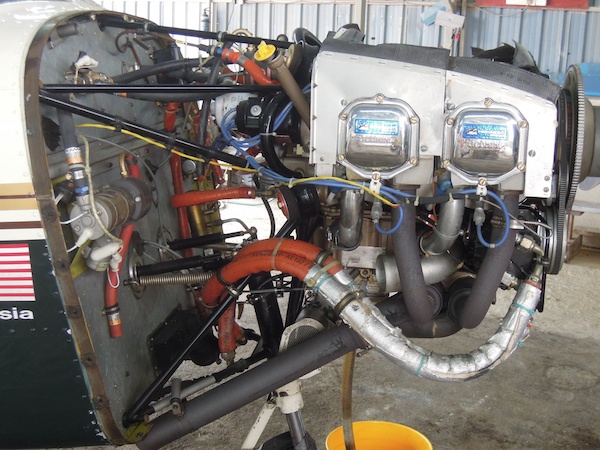
Lycoming O-360-A4M in Piper Archer III

While I usually fall asleep halfway through most Hollywood movies, I could spend hours watching machines to figure out how they work. And so I was looking forward to the first 50 hours maintenance to document in detail what lies under the engine cowling of 9M-DRJ.

My plane is equipped with a normally aspirated four-cylinder four-stroke, horizontally opposed, air-cooled granddaddy of an engine. Clearly not cutting edge anymore, but rock-solid. This sort of machine will give you ample warning before it quits. It won’t just stop out of nowhere like one of the new diesel engines that rely on lots of electronics. On the flip-side, this engine practically needs to be bathed in oil and fuel to run smoothly.

Nevertheless, quite a number of components need to work together in a well-coordinated manner even for this unsophisticated engine to run. You need the fuel system with pump and carburetor, the oil system with cooler, filter and pump, the spark with magnetos and spark plugs, the starter motor, the exhaust system and of course the motor block with cylinder heads, pistons, valves etc.

If you are interested in this sort of stuff, you can take a look at a couple of pictures I have taken of this little marvel of technology