Ingo Noka

Posts Tagged ‘knowledge’

Do you speak English?

In Knowledge, Private Pilot License on October 11, 2013 at 6:40 pm

Better write down what ATC is saying. I am not that young anymore.

So you think you speak English?  You are even born in a country that has English as the mother tongue?  Interesting, but DCA Malaysia wants to make sure.  And that means every pilot and air traffic controller has to do an English proficiency test.  The test will tell whether you have a pre-elementary knowledge of English (the lowest score) or whether you are an expert (the highest score).  If you fail the test (score 1 to 3) you are not a pilot anymore, no matter what your license says. And, unless you are an expert, you have to repeat the proficiency test every three years (score 4) or six years (score 5).  Only experts can forget about this for the rest of their Malaysian pilot career. (BTW: The English test has not been invented in Malaysia.  This is an ICAO requirement and has been implemented in one form or other by most countries in the world.)

My last score was a 4 and the three years will expire tomorrow.  So, I went on a Firefly flight to Subang this morning and reported at APFT (one of the approved test centers in Malaysia) to take my test.  I was secretly hoping for a six rating, but I got a five.  Not a bad result.  I won’t need to do that again for six years.  The best part of this is that I was able to take the results to DCA in Putrajaya right away and they updated my license on the spot.  Free skies of Asia – I am back in business. Off to Medan tomorrow.

Read the rest of this entry »

Weekend Flying Summary

In Knowledge, Navigation, Social Life, Weather on August 25, 2013 at 9:05 pm

Flying around the clouds at 4000 feet

I had a nice dinner with the Extreme Midlife Aerobatics team at a restaurant call Berliner’s , named after the city in Germany I am coming from.  It was great to catch up with people who are as passionate about flying as I.

Graham told me that despite all problems they may have had, Bernam River Airfield is open for business.  This will be one of my next flying destinations.  Bernam River Airfield lies half way between Subang and Ipoh (it is included in my VFR reporting points list) and should be an excellent starting point for excursions into Pangkor, Penang or even Langkawi.  I believe they  have a few cabins for overnight stay.  Given that Subang has become rather inconvenient for overnight stays, this little airfield is becoming attractive for weekend flyers.

Read the rest of this entry »

Flight Plans in Malaysia

In Flight Bag, Knowledge, Navigation on June 16, 2013 at 10:54 am

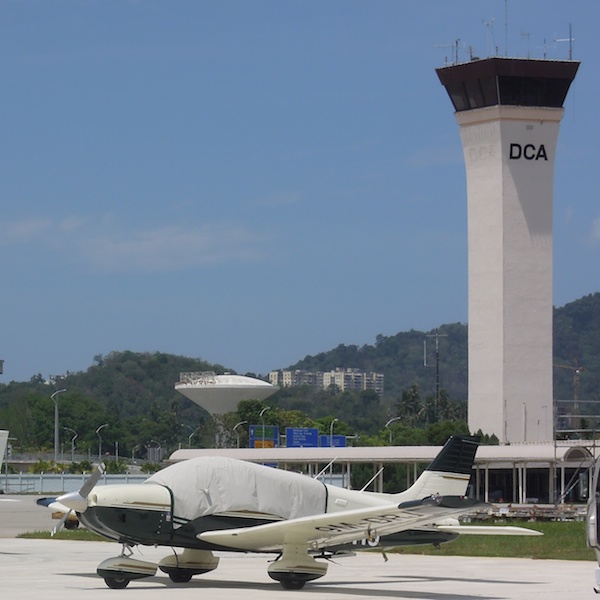
DCA Tower Penang

The Malaysian ATC expects you to file a flight plan for all VFR flights, unless you just stay in the training areas or do a few circuits to practice your landings.

Most pilots will fill in a flight plan form on paper and fax it to the ATC unit of the departure airport. ATC will forward the FPL using the usual data exchange network. That means most of the formatting will be done by the controller and the pilot does not really need to know much about the FPL message formats.

As soon as you are crossing borders, this changes, however. Suddenly you are confronted with the need to send your flight plan to all control units along your proposed route and you have to be careful with the formatting and completeness of your flight plan message.

I have found two flight plan filing systems that work very well for me. The first one is a web based system from the UK, which is available under www.eurofpl.eu. The second one is a Java application that is provided by the Singapore CAAS.

All three methods (fax, web, application) have their benefits and issues. I personally prefer the web-based system, followed by the Java application and finally the fax.

I usually combine the fax method with an online fax application called eFax. With my iPhone acting as a personal hotspot for my laptop, I am able to fax flight plans from anywhere, including the parking apron.

In my next posts on this topic, I’ll give you an overview of how the three methods work and how flight plan messages are formatted in general.

Two Countries in Ten Minutes

In Flight Bag, Knowledge, Navigation on April 7, 2013 at 9:55 pm

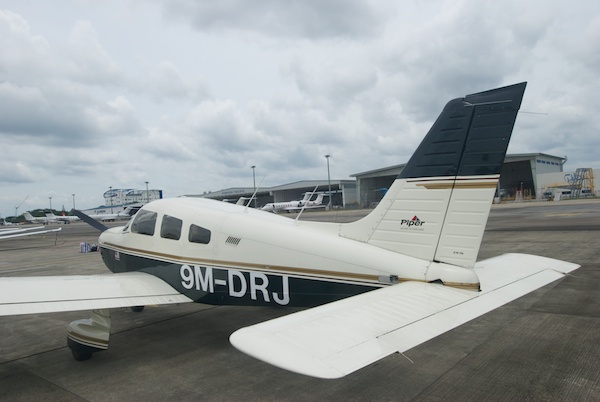
9M-DRJ in its parking spot at Seletar Airport (Compact Parking A2)

5 April 2014: Note that for flights between Seletar and Senai airport the first reporting point in Malaysia after Point X-Ray is not the small hill (East of JB town) anymore.  The new reporting points are now Tebrau City Mall and Felda Ulu Tebrau. I have updated my VFR reporting point files (click here)  and you can also have a preview on Google Maps (click here).

1 May 2013: Updated the process to file general declaration forms for departure.  It is now necessary to bring three GenDex forms to the Apron office.  Apron will keep two forms and hand back the third one with a big stamp on it that proves you have paid the passenger fee or that you do not have passengers.  The GenDex with the stamp need to be handed to the immigration officer.

Since I started to fly 9M-DRJ, which has a parking space in Singapore, Seletar airport, I routinely fly between Singapore and Johor.  The flight is very short (15 to 20 minutes) and I think it is pretty cool that you can hop over to Johor for a quick chat any time you want to.  Of course, flying to any other place in Malaysia is also more convenient.  The immigration and customs control in Seletar is very fast, friendly and efficient.  From leaving home (East Coast) to taking off can be accomplished in less than an hour.

Before I started flying from Seletar I heard stories about inflexible ATC procedures, but I have not experienced this.  Of course, safety is paramount, but within the confines of the procedures Seletar tower is very accommodating and flexible.  If they can make it happen without compromising security they will.  Just asked nicely and with proper radio protocol and you will be fine!

I only know ground operations West of the runway. The assumption in my post is that you will fly between Seletar and Senai airport. For Tioman and other directions over the Malaysian peninsular, just change the reporting points after “East of JB Town”.

Read the rest of this entry »

Buying an Airplane II

In Equipment, Gear, Ownership on March 2, 2013 at 11:15 pm

9M-DRJ and me

Hurray – I bought an airplane! You probably ask whether I ended up buying the Cessna 182 or the Diamond DA40.  Well, neither.

The thing is that I forgot to talk about money in my first post.  The issue is that you need to have enough money left to maintain and fly the aircraft.  If you max out your budget buying the plane, you won’t be happy.

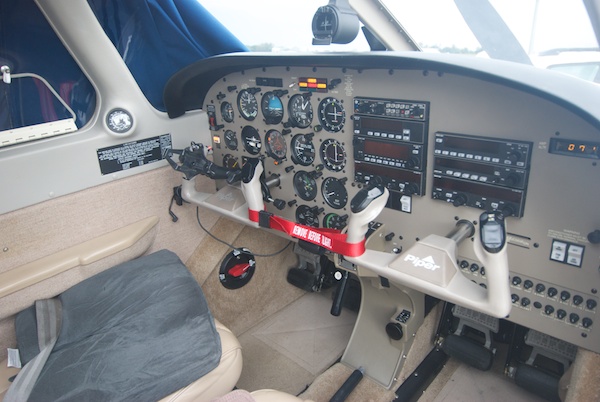
So I decided to go for a relatively new and affordable Piper Archer III.  It does not have a glass cockpit.  The instruments are all analog with two VOR/Localizer CDIs one glide-slope indicator, ADF, KAP140, KLN89B, etc. – basically the original Silvercrown Bendix/King stack. One of the coolest features is the Piper Aire air conditioning.  I don’t think you can go wrong with an a/c in the tropical climate down here.   The call sign is 9M-DRJ and I will post a lot more about my new toy.

9M-DRJ Instrument Panel

Read the rest of this entry »

VFR Reporting Points

In Flight Bag, Navigation on February 10, 2013 at 10:33 pm

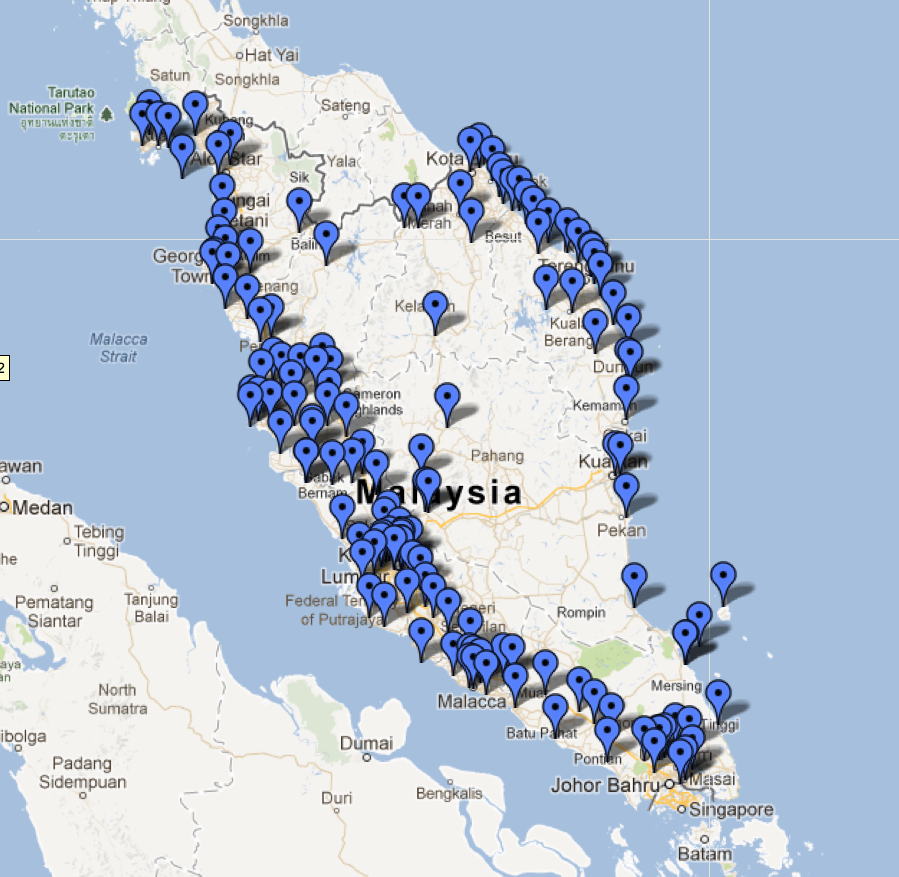
VFR Reporting Points on the Malaysian Peninsula

28 April 2013: Added waypoints along the east coast and two routes from KL to Kota Bahru.

In Malaysia ATC follows all VFR flights regardless of the classification of the airspace and pilots must submit a flight plan for all VFR cross-country flights.  This practice requires some common understanding of acceptable reporting points between VFR pilots and ATC.  Given the importance of reporting points for VFR flying in Malaysia, there is surprisingly little information and documentation about them.  As I have written in my post about the availability of aviation charts, there is no such thing as up-to-date sectional charts that could be used for flight planning and pilotage navigation.  for small parts of the airspace (Langkawi, Johor, Tioman, KL) I have tried to rectify this by drawing my own maps, but this is a very poor replacement for proper charts.

In addition to drawing my own charts, I have also collected reporting points I have used in my cross-country flying.  And with this post, I am going to share this information (download different versions here V1 V2 V3 V4 V5).  Most pilots own GPS devices and use them for navigational purposes.  Some devices or applications on the iPad or iPhone can import geographical points in certain formats, so I am providing the data in GPX format as well.  I am able to convert this file into other formats, so if you tell me what you need, I may be able to help.  I would certainly be interested in hearing if you have been successful in using the file with your GPS device or application.  I do know for certain that the file can be imported into Google Maps and into the MotionX GPS application on the iPad and iPhone.

Read the rest of this entry »

Buying an Airplane – Part I

In Equipment, Ownership, Private Pilot License on December 9, 2012 at 4:08 pm

Diamond DA40 Test

I have decided to buy an aircraft. Whether that is a wise decision is questionable, but for me it is the right one.

To be honest, there is no business case for this. Renting is likely the cheaper option even if I am going to fly a lot. With renting I would have no maintenance headaches, no unexpected costs, zero cost when I am not flying and so forth.

So the question is, whether the extra hassle and money would be worth it. For me the answer is ‘Yes” for these reasons:

Read the rest of this entry »

Watch your Weights

In Airmanship, Flight Bag, Knowledge on September 18, 2012 at 12:13 am

This pilot has become rather heavy. Time to brush up on W&B!

During our flight training we have all learned how to do the weight and balance calculations and we have been told that this is something we must do before every flight.  Of course, even then, many of us thought this exercise was only good for watching the instructor’s reaction when you filled in his weight (for the examiner your estimate better had to be on the low side).

For me this was the state of affairs for the first 100 hours of my PPL “career”.  However, lately I am flying more and more with passengers and luggage, so I thought I’d better brush up on my W&B knowledge. As things go these days, my first thought was whether there is an App for that, and sure enough there are plenty.  In one of my next posts I will review an excellent application from Angell Development LLC by the name of WnB Pro.

Let’s talk first about the theory of W & B.  As usual the FAA has very good materials on their web site (Aircraft Weight and Balance Handbook, FAA-H-8083-1A).  I recommend reading this document if you are really serious about this stuff.

Read the rest of this entry »