Ingo Noka

Posts Tagged ‘ATC’

A new challenge – Thailand, Part III

In Flight Log, Knowledge, Navigation on July 24, 2013 at 1:24 pm

Saturday is getting closer and with this my flight to Thailand. I am so looking forward to an entire week of flying in Singapore, Malaysia and Thailand. Apart from the Thailand flight, which has a fixed route and timing, I will fly wherever the wind takes me. Heaven!

The Thai flight permit came through last Thursday. That was surprisingly fast and without much of a problem. I am cleared for a flight to VTSS and VTSW on Saturday and back on Monday. I am allowed to postpone by up to 24 hours, after which I will have to ask for a new permit.

Phuket Airpark kindly sent me an invitation letter, which helped with the Thai VFR permit. They are a bit concerned with some guy they don’t know flying into their short, soft grass strip and I will certainly try to get my landing and take-off right to be welcome again at some time in the future.

The only uncertainty is now the availability of Avgas in Hat Yai. It would be extremely disappointing if I had to cancel at the last minute, because of that. Maybe I would just fly into Hat Yai and come back, which is short enough to get away without refueling outside of Malaysia.

Read the rest of this entry »

Flight Plans in Malaysia

In Flight Bag, Knowledge, Navigation on June 16, 2013 at 10:54 am

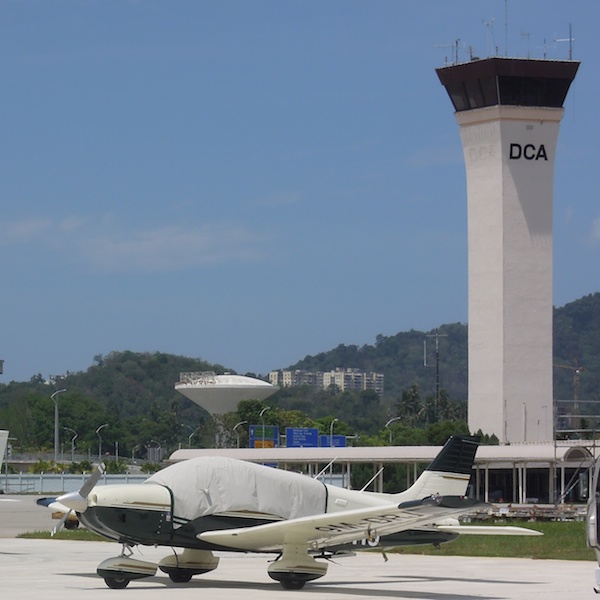
DCA Tower Penang

The Malaysian ATC expects you to file a flight plan for all VFR flights, unless you just stay in the training areas or do a few circuits to practice your landings.

Most pilots will fill in a flight plan form on paper and fax it to the ATC unit of the departure airport. ATC will forward the FPL using the usual data exchange network. That means most of the formatting will be done by the controller and the pilot does not really need to know much about the FPL message formats.

As soon as you are crossing borders, this changes, however. Suddenly you are confronted with the need to send your flight plan to all control units along your proposed route and you have to be careful with the formatting and completeness of your flight plan message.

I have found two flight plan filing systems that work very well for me. The first one is a web based system from the UK, which is available under www.eurofpl.eu. The second one is a Java application that is provided by the Singapore CAAS.

All three methods (fax, web, application) have their benefits and issues. I personally prefer the web-based system, followed by the Java application and finally the fax.

I usually combine the fax method with an online fax application called eFax. With my iPhone acting as a personal hotspot for my laptop, I am able to fax flight plans from anywhere, including the parking apron.

In my next posts on this topic, I’ll give you an overview of how the three methods work and how flight plan messages are formatted in general.

Exhilarating and scary – VFR around Monster Thunderstorms

In Airmanship, Flight Log, Navigation, Weather on April 22, 2013 at 12:17 pm

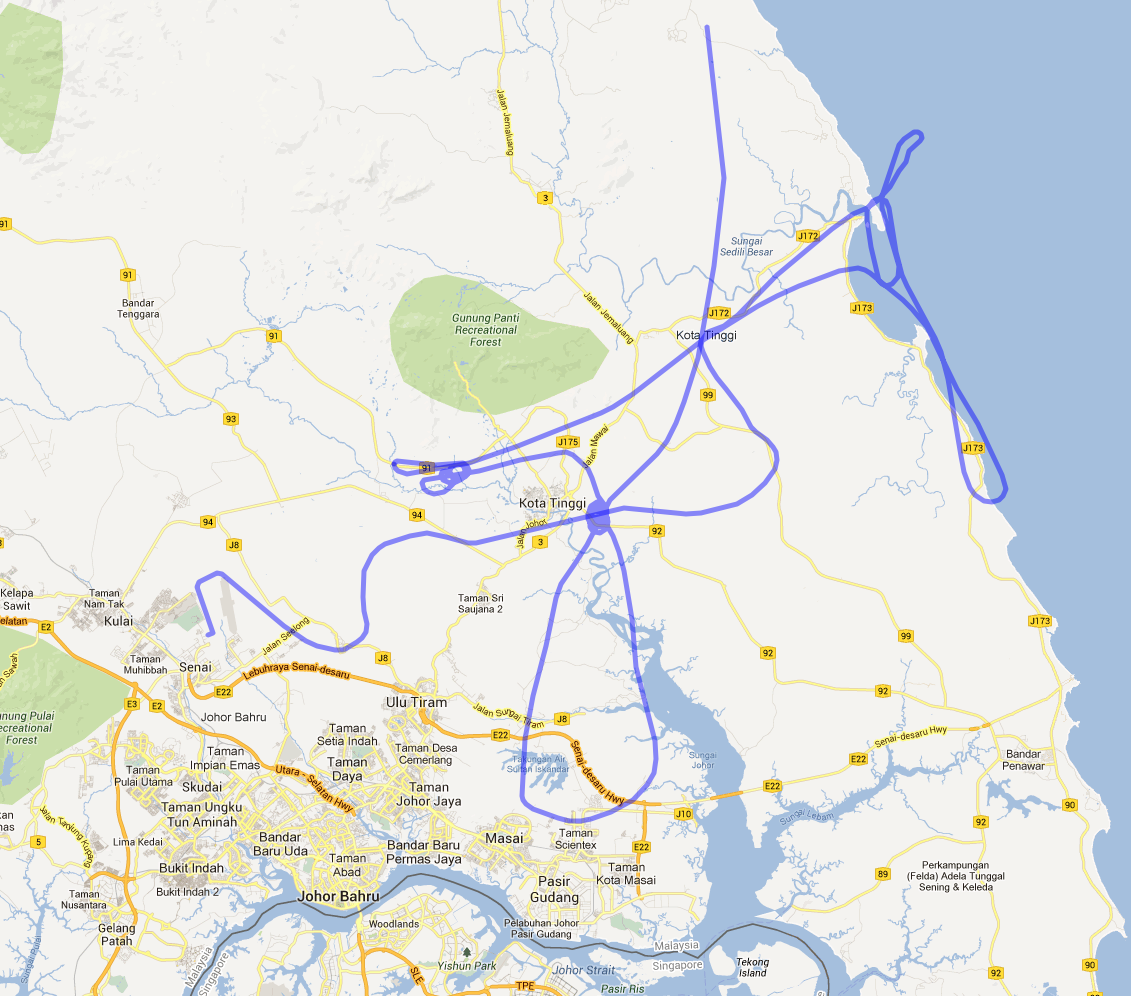
This is not how a straight in approach to Seletar is supposed to look like

As the saying goes, pilots start off with a ton of luck and no experience and hope to gain enough experience before their luck runs out. I used up a good portion of luck and learned a lot of things yesterday.

On my way back from Kota Bahru, an uneventful three hour cross-country flight was crowned by one and a half hour of the most challenging and scary flying I have ever done.

Within 30 minutes, a couple of rapidly growing and fast moving thunderstorms put Johor, Seletar, Subang and Tioman into IMC – all at the same time.

Mind you, I am not talking about a bit of bad visibility that is crappier than what we normally deal with in South East Asia. I am talking about the big black impenetrable blanket that cover large junks of the land.

While orbiting next to one of those monsters my ground speed in one 360 degree turn varied by 70 knots! The aircraft was going up and down so rapidly that the AP disengaged, my headset flew off and I banged my head into the ceiling so badly hat I saw stars in the clouds. (Advice from the “Been there, done it” department : truly tighten the seat belts and do not just chant this point on the check list. )

If you know the layout of the airports in Malaysia, you will also know that there was literally no viable option to land anymore and I was at the end of a 3 hour flight with about 2 hours endurance left if I would have flown the tanks empty.

So I was flying up and down the East coast between Sidilli Besar and Desaru to find an opening, but every time I thought I had found something, ATC told me that the weather radar looks even worth where unwanted to go.

Eventually, ATC negotiated with Singapore a 4000 feet climb and track to VJB, which is the VOR station there. With the up- and down-drafts yanking me around like mad I even had problems to remember what a VOR was, let alone how to track to one. However, many hours of lonely flying in my new airplane with plenty of time to play around with the avionics paid off.

I managed to go in the right direction, but lost my nerves close to Kota Tinggi, where I descended to 1000 feet again to track the ground.

Again, many flights to Mersing in the past gave me the confidence to navigate by ground features alone. I was even able to identify the danger areas by the the change in vegetation, but why I bothered to avoid the areas when I thought I might not make it to the airfield is one of those mysteries…

Finally I had the airfield in sight and what a beautiful sight it was! I guess this put me into such a calm and relaxed Zen state that I did one of my best landings ever – an absolute greaser. (Good landings only happen when nobody else is in the aircraft to witness it. But whether you believe me or not, I know what I saw… Or maybe my butt was just desensitized. )

After big thunderstorms the view is often gorgeous, with unlimited visibility and haze rising out of the jungle in columns. And that was the sight Mother Nature greeted me with on my flight from Johor to Seletar in cool air and just the slightest drizzle. Maybe it was an apology for her earlier misfits?
Two Countries in Ten Minutes

In Flight Bag, Knowledge, Navigation on April 7, 2013 at 9:55 pm

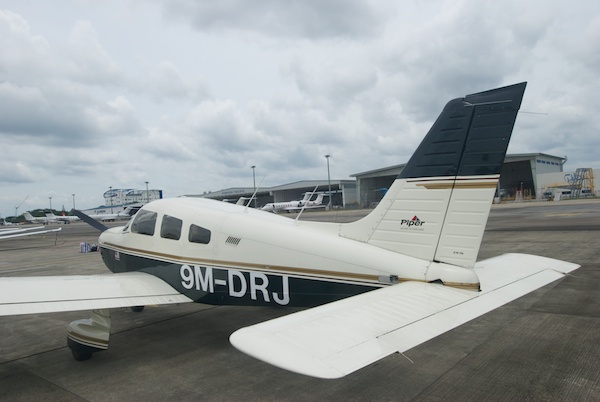
9M-DRJ in its parking spot at Seletar Airport (Compact Parking A2)

5 April 2014: Note that for flights between Seletar and Senai airport the first reporting point in Malaysia after Point X-Ray is not the small hill (East of JB town) anymore.  The new reporting points are now Tebrau City Mall and Felda Ulu Tebrau. I have updated my VFR reporting point files (click here)  and you can also have a preview on Google Maps (click here).

1 May 2013: Updated the process to file general declaration forms for departure.  It is now necessary to bring three GenDex forms to the Apron office.  Apron will keep two forms and hand back the third one with a big stamp on it that proves you have paid the passenger fee or that you do not have passengers.  The GenDex with the stamp need to be handed to the immigration officer.

Since I started to fly 9M-DRJ, which has a parking space in Singapore, Seletar airport, I routinely fly between Singapore and Johor.  The flight is very short (15 to 20 minutes) and I think it is pretty cool that you can hop over to Johor for a quick chat any time you want to.  Of course, flying to any other place in Malaysia is also more convenient.  The immigration and customs control in Seletar is very fast, friendly and efficient.  From leaving home (East Coast) to taking off can be accomplished in less than an hour.

Before I started flying from Seletar I heard stories about inflexible ATC procedures, but I have not experienced this.  Of course, safety is paramount, but within the confines of the procedures Seletar tower is very accommodating and flexible.  If they can make it happen without compromising security they will.  Just asked nicely and with proper radio protocol and you will be fine!

I only know ground operations West of the runway. The assumption in my post is that you will fly between Seletar and Senai airport. For Tioman and other directions over the Malaysian peninsular, just change the reporting points after “East of JB Town”.

Read the rest of this entry »

VFR Reporting Points

In Flight Bag, Navigation on February 10, 2013 at 10:33 pm

VFR Reporting Points on the Malaysian Peninsula

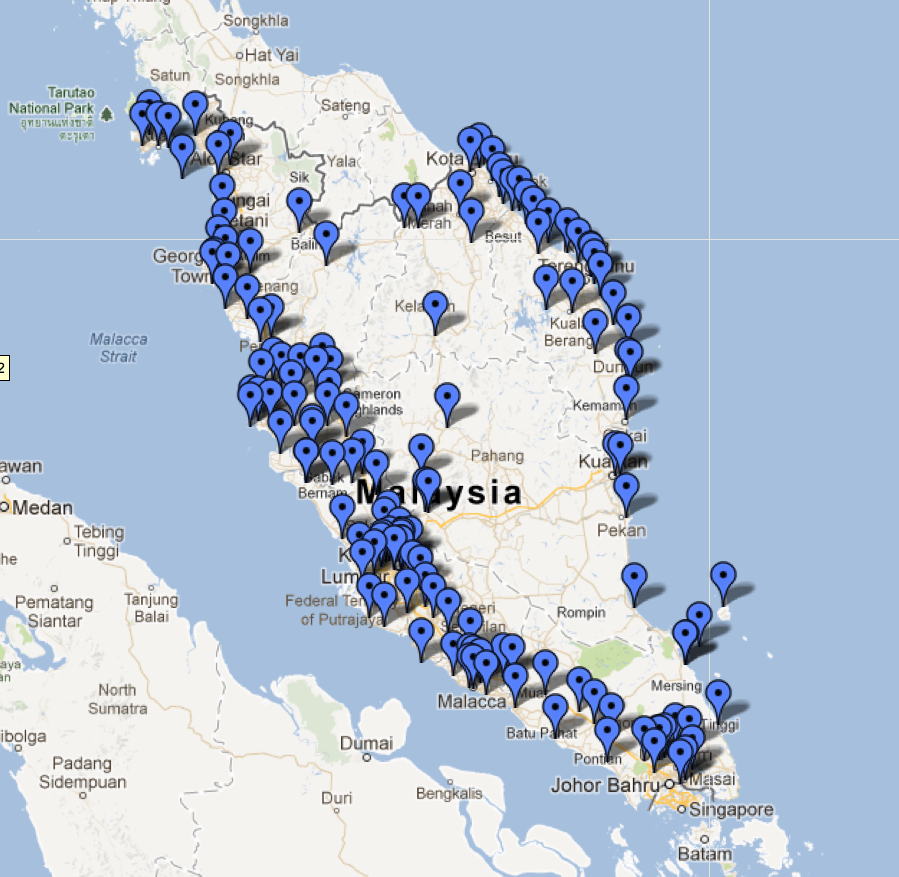
28 April 2013: Added waypoints along the east coast and two routes from KL to Kota Bahru.

In Malaysia ATC follows all VFR flights regardless of the classification of the airspace and pilots must submit a flight plan for all VFR cross-country flights.  This practice requires some common understanding of acceptable reporting points between VFR pilots and ATC.  Given the importance of reporting points for VFR flying in Malaysia, there is surprisingly little information and documentation about them.  As I have written in my post about the availability of aviation charts, there is no such thing as up-to-date sectional charts that could be used for flight planning and pilotage navigation.  for small parts of the airspace (Langkawi, Johor, Tioman, KL) I have tried to rectify this by drawing my own maps, but this is a very poor replacement for proper charts.

In addition to drawing my own charts, I have also collected reporting points I have used in my cross-country flying.  And with this post, I am going to share this information (download different versions here V1 V2 V3 V4 V5).  Most pilots own GPS devices and use them for navigational purposes.  Some devices or applications on the iPad or iPhone can import geographical points in certain formats, so I am providing the data in GPX format as well.  I am able to convert this file into other formats, so if you tell me what you need, I may be able to help.  I would certainly be interested in hearing if you have been successful in using the file with your GPS device or application.  I do know for certain that the file can be imported into Google Maps and into the MotionX GPS application on the iPad and iPhone.

Read the rest of this entry »

West coast weekend flying

In Flight Log, Navigation on December 4, 2012 at 6:22 pm
Sunset over Pulau Paya

Sunset over Pulau Paya

Flight Summary
Engine Time 14h 43m
Landings 8
Fuel total 94 Gallons
Fuel per hour approx. 7 Gallons (26.5 Liters)
Hotel cost approx. RM 700 (SGD 280)
Pictures Click here

The trip from Johor to Langkawi presented most of its challenges while we were on the ground than being in the air.  In Johor the fuel bowser was broken, in Subang we arrived at an unfortunate time (lunch) and in Penang the fuel truck wouldn’t start.  Thankfully the weather was on our side and we made it to Langkawi despite all the delays.  For our troubles, mother nature rewarded us with a gorgeous sunset over Langkawi. With the last rays of sunshine we just about made into Langkawi airport around 19:00.

Read the rest of this entry »

Subang live updates

In Navigation on October 6, 2012 at 9:42 am

20121006-124328.jpg

On my way to Subang. Intention is to fly to Pangkor later.

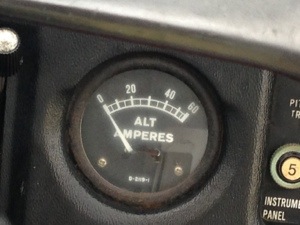
Big scare. After Cape Ricardo the electrical system of the aircraft went completely dead. The handheld radio wasn’t strong enough to reach Lumpur Info. Eventually I managed to contact another aircraft and got cleared to Subang. In Subang the handheld radio worked and they let me land. Of course in between the batteries of the handheld had to be changed too.

That was not a pleasant experience. The battery is now completely dead, which means the alternator wasn’t charging.

I hope to get it fixed by tomorrow so that I can fly back by plane.

Tioman Checkout

In Flight Bag, Navigation on July 23, 2012 at 11:26 pm

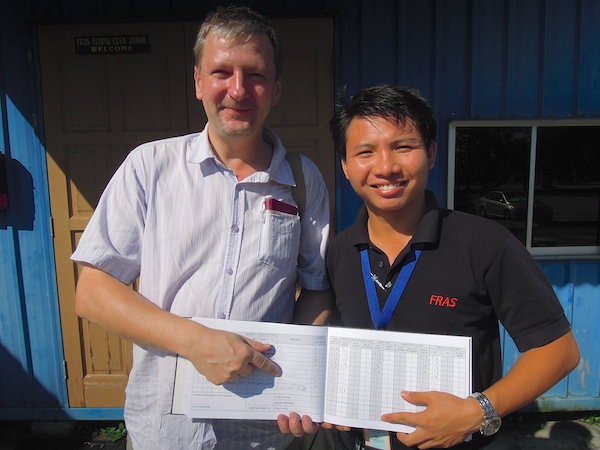
Ingo and Saddiq after Tioman Checkout

Pulau Tioman was the last island with a usable airfield around the Malaysian peninsula I hadn’t been to.  One reason is that I was busy exploring the other places along the East and West coast, and the other reason is that you need to get checked out by a flight instructor first before you can fly there on your own.  The FRAS checkout consists of three successful landings with a flight instructor.

My first attempt failed.  Last weekend, I stayed a couple of hours at the club hoping that the weather would clear enough to have a good chance to return to Johor, but no such luck.  This weekend, the weather was better.  Lots of CB with a base of about 2000 feet and nice blue sky in between.  On Saturday, I practices a couple of landings and on Sunday Saddiq was available and the weather still held, so we took off at around 13:00.  With a tail wind of 10 to 12 kts, we arrived at Tioman a bit after 14:00.  Saddiq did a good job briefing me about the approach and I managed to slam the piper into the runway with lots of room to spare.  I had the same problems as in Pangkor – too slow on approach and not enough flare.  Nevertheless, I did two more landings to satisfy the club requirements and we went back with no drama.  Now I am signed off for Tioman and hope to get back there on my own soon.

For the readers of my blog, I have drawn a little map and provide a couple of notes on the procedures to approach and land in Tioman.  You can download the Tioman map here.

Read the rest of this entry »

Have a look at Pulau Rawa

In Flight Log, Navigation on February 27, 2012 at 12:07 am

Flight Log Pulau Rawa on 26 February 2012

Today I went to Pulau Rawa (a little island East of Mersing) and since I have now done it twice, I thought I would give some advice to fellow pilots who want to fly this beautiful VFR route.

Some basic information about this route:

  • Distance: 144 nm
  • Realistic time with about 5 to 10 minutes over Pulau Rawa: 1 hour 55 minutes
  • AT4 fuel usage: 38 liters
  • Flight log: download link (Apple Pages Format, this link is not going to be updated!)
  • Flight plan: download link (Apple Pages Format, this link is not going to be updated!)

Read the rest of this entry »

All Well with Port Weld

In Flight Bag on January 29, 2012 at 10:58 pm

Frederic Weld (1823-1891)

Finally the mystery of reporting point Port Well has been resolved.  We know where Port Well is, in fact we know Port Well does not exist.  If it ever existed it would have been Port Weld, which is a name that is not used anymore.  The actual name is Kuala Sepetang, and it must have been that way for quite some time, considering that our 40 years old maps already use it.  ATC in Malaysia is certainly not changing things around in a rush.

For over a year the fearless aviators of the FRAS flying club had to rely on wild guesses to determine where this reporting point “Port Well” might be.  ATC surely never explained it and no map or AIP document mentions the place.  Nevertheless, without fail, Lumpur Info or Ipoh tower would ask for a report at Port Well.  Until now, our chief flight instructor Captain Singh (Kevin Muk got a job that does not allow him to fly anymore) determined that Port Well must be somewhere between Pantai Remis and Bagan Serai, probably at the border of the Ipoh TMA. Read the rest of this entry »